Environmental sustainability and targets
We are committed to continuously improving the environmental sustainability of our operations, guided by our environmental policy. Efficient material use, optimized production, and resource management, together with our SBTi-aligned targets and emissions reduction roadmap, guide us toward significantly reducing our environmental impact.
At Okmetic, our commitment to the environment guides all our operations. We believe that responsible environmental practices not only support sustainable growth but also create long-term value for our customers, employees, and society. Our environmental policy is built on five core principles:
- Strict regulatory compliance
- Minimizing environmental impacts
- Proactive risk management
- Continuous improvement
- Strong partnerships
Okmetic holds a valid environmental permit, and our operations and products meet or exceed the requirements of environmental legislation and international standards such as ISO 14001.
We actively manage the key environmental impacts of our production, including energy, water, chemical use, and waste generation. Through continuous improvements, we strive to reduce these impacts and promote sustainable practices. Read more in our Sustainability report.
Our emissions reduction targets have been validated by the SBTi
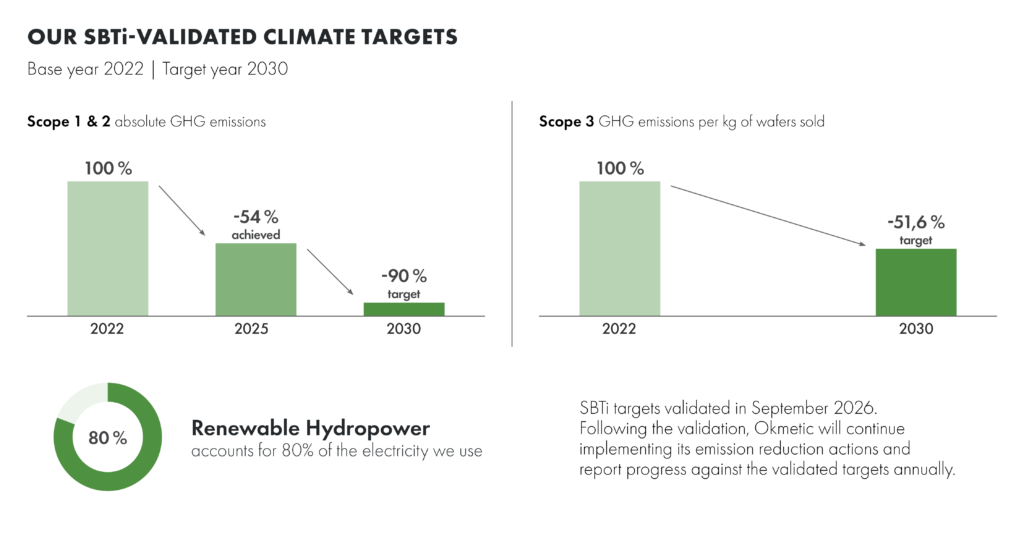
Our greenhouse gas (GHG) emission reduction targets have been validated by the Science Based Targets initiative (SBTi).
We commit to reduce absolute scope 1 and 2 GHG emissions 90% by 2030 from a 2022 base year. We also commit to reduce scope 3 GHG emissions 51.6% per kg of wafers sold within the same timeframe.
In 2025, we took a significant step toward reducing our emissions by sourcing 80% of our electricity from renewable hydropower. As a result, we have already reduced our Scope 1 and 2 emissions by 54% compared to our 2022 baseline.
Environmental policy and certifications guide our operations
We use quality and environmental systems compliant with ISO 9001:2015, ISO 14001:2015 and IATF 16949:2016 standards, and we require ISO 9001 and ISO 14001 certification even from our most significant contract manufacturers and suppliers.
We are audited by external partners every four years in accordance with the EU Energy Efficiency Directive (2023/1791). Our approach is recognized as ISO 50001-aligned under the EU directive.
Additionally, our products meet the requirements of the REACH Regulation and RoHS Directive.
We develop the environmental sustainability of our products and operations by also utilizing the results of customer audits.
We manage environmental risks under the entire company’s overarching operations as well as individual processes. Preventive planning is an important aspect in the management of environmental risks.
Advancing resource efficiency through material management
Our goal is to optimize the consumption of raw materials, energy, and water in relation to production volume through efficient production and continuous improvement.
The use of polysilicon has been identified as a significant environmental factor in our operations. We strive to minimize the amount of polysilicon that ends up as waste by optimizing crystal growing processes. In addition, we produce recycled silicon from the unused parts of silicon crystals, which we can still utilize in our production, and a significant portion of the silicon waste is being recycled by our partner. In 2025, we increased the recycling rate of silicon waste to 51 percent from 35 percent of the previous year.