CEO Kai Seikku: Semiconductor industry growth requires a sustainable materials ecosystem
Semiconductor technologies are becoming more complex, specialized and performance-driven, placing growing demands across the semiconductor value chain. In MEMS, RF, sensor and power semiconductor applications, advanced materials play a growing role in device performance alongside advances in device architecture, packaging and manufacturing.
The semiconductor market has returned to growth following the recent downturn, but the recovery has been uneven across the value chain. While several parts of the industry have seen strong revenue growth, the silicon wafer market has developed more slowly. Shipment volumes have begun to increase, while revenue growth has remained limited amid continued pricing pressure.
The recovery in silicon wafer demand is now broadening. While 300 mm wafers led the initial upturn, demand for 150–200 mm wafers has also returned to growth in 2026. At the same time, rising manufacturing costs and increasing technical requirements continue to put pressure on the economics of silicon wafer production.
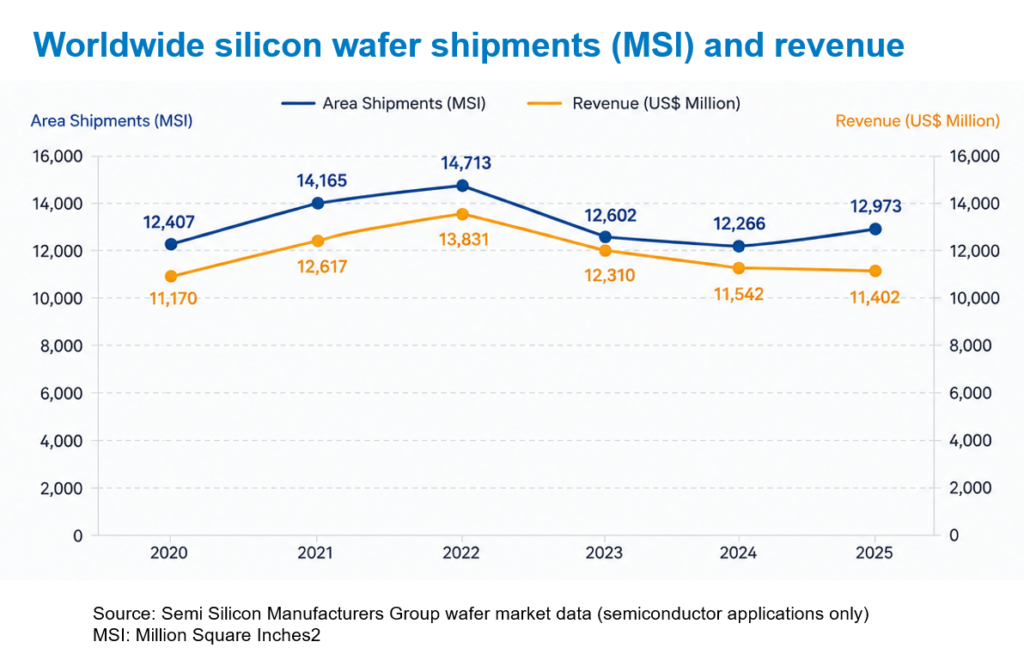
Worldwide silicon wafer shipments are recovering from the 2022 market peak and subsequent downturn, while continued pricing pressure has constrained revenue growth. In H1 of 2026, silicon wafer shipments increased by 10% year over year.
Materials as performance enablers
The growing strategic role of materials is especially visible in MEMS, sensor, RF and power semiconductor applications, where engineered silicon wafers directly influence device performance, yield, process stability, and long-term reliability.
As device architectures become more application-specific, semiconductor innovation is no longer driven only by device scaling, but increasingly by how effectively materials, epitaxy, process integration and device architectures are optimized together.
Increasing semiconductor complexity and strengthening demand require sustained investment in application-specific substrate engineering, R&D and manufacturing capabilities. At Okmetic, we continue to invest in the technology, people and manufacturing capabilities needed to support our customers while continuously improving operational efficiency.
Maintaining these capabilities and continuing the investments required to meet growing customer needs require an economically sustainable foundation. Pricing that reflects increasing costs, technical requirements and investment needs is essential to sustaining the performance, quality and reliable supply our customers expect. More broadly, a technologically strong and economically sustainable materials ecosystem is critical to long-term innovation, supply resilience and semiconductor industry competitiveness.